






What is Mineral Swim?
A pool that runs on 100% Dead Sea minerals instead of pool salt, with an ozone purifier working beside the chlorinator. It still makes its own chlorine — far less of it: 0,5–1,0 ppm where a conventional pool holds 2,0–3,0.
The short answer
Mineral Swim is a pool system made by Maytronics. It replaces ordinary pool salt with 100% Dead Sea minerals, makes its own sanitiser from them in a mineral chlorinator, and adds an ozone purifier to do the heavy cleaning — so the pool can hold 0,5–1,0 ppm free chlorine instead of the 2,0–3,0 ppm of a conventional pool.
It is not a chlorine-free pool, and Maytronics say so themselves. It is a low-chlorine pool where the chlorine is made for you: no drum to buy, carry or pour.
Minerals, not pool salt
Magnesium-rich minerals from the Dead Sea dissolve into the water where pool salt would go. A typical pool needs 4–5 bags a year once it is established.
A cell that makes the chlorine
As water passes through the chlorinator, the cell turns the dissolved chloride into sanitiser and holds a small, steady residual. Nobody doses by hand.
Ozone that does the heavy lifting
The purifier adds ozone to the water on its way back to the pool, breaking down sweat, sunscreen and organics. Maytronics rate ozone as working up to 3 000 times faster than chlorine.
Want the chlorinator now and the ozone later? EcoSwim is the chlorinator on its own, built to take the purifier when you are ready.
It starts at the Dead Sea
For thousands of years, people have travelled to the Dead Sea for its mineral-rich water and its reputation for health and well-being. Mineral Swim is the pool system Maytronics built to bring those minerals home — at a strength you swim in, not float on, and with far less chlorine than a conventional pool.
- Thousands of years
A lake nothing can live in
The Dead Sea lies at the bottom of the Jordan Rift Valley, its shore more than 430 metres below sea level — the lowest land on Earth. Water flows in and none flows out, so it leaves only by evaporating and the minerals stay behind. The result is about 34% salt, close to ten times saltier than the ocean. Fish and plants cannot live in it, which is how it got its name.
- What is in it
Magnesium, not sodium
Ordinary sea salt is about 85% sodium chloride. The Dead Sea’s is different: roughly half of it is magnesium chloride, with sodium, calcium and potassium chlorides making up the rest. That magnesium is what makes a mineral pool a mineral pool.
- 1983
Maytronics begins
On Kibbutz Yizre’el in northern Israel, Maytronics starts building the Dolphin robotic pool cleaner. The story has a South African thread: the robot the kibbutz started with grew out of a South African invention whose rights it bought.
- 2024
Mineral Swim V2
Maytronics Australia, in that market since 2010, opens a production line for the current generation, Mineral Swim V2. The V2 Pro pairs the mineral chlorinator and the ozone purifier in one control unit.
- Today
In South African pools
The V2 Pro range and EcoSwim are sold and supported in South Africa, alongside the Dolphin cleaners the company started with. See the Mineral Swim range.
Two salts, side by side
Share of each salt by weight. The Dead Sea figures come from a published analysis of its dissolved salts; the ocean figure is the usual approximation.
- Magnesium chloride ~51%
- Sodium chloride ~30% of Dead Sea salt, ~85% of ocean salt
- Calcium chloride ~14%
- Potassium chloride ~4%
- Other ocean salts ~15%
A Mineral Swim pool is nowhere near Dead Sea strength. It runs at 3 500–6 500 ppm of dissolved minerals — well under 1% — where the Dead Sea is about 34%.
Follow the water
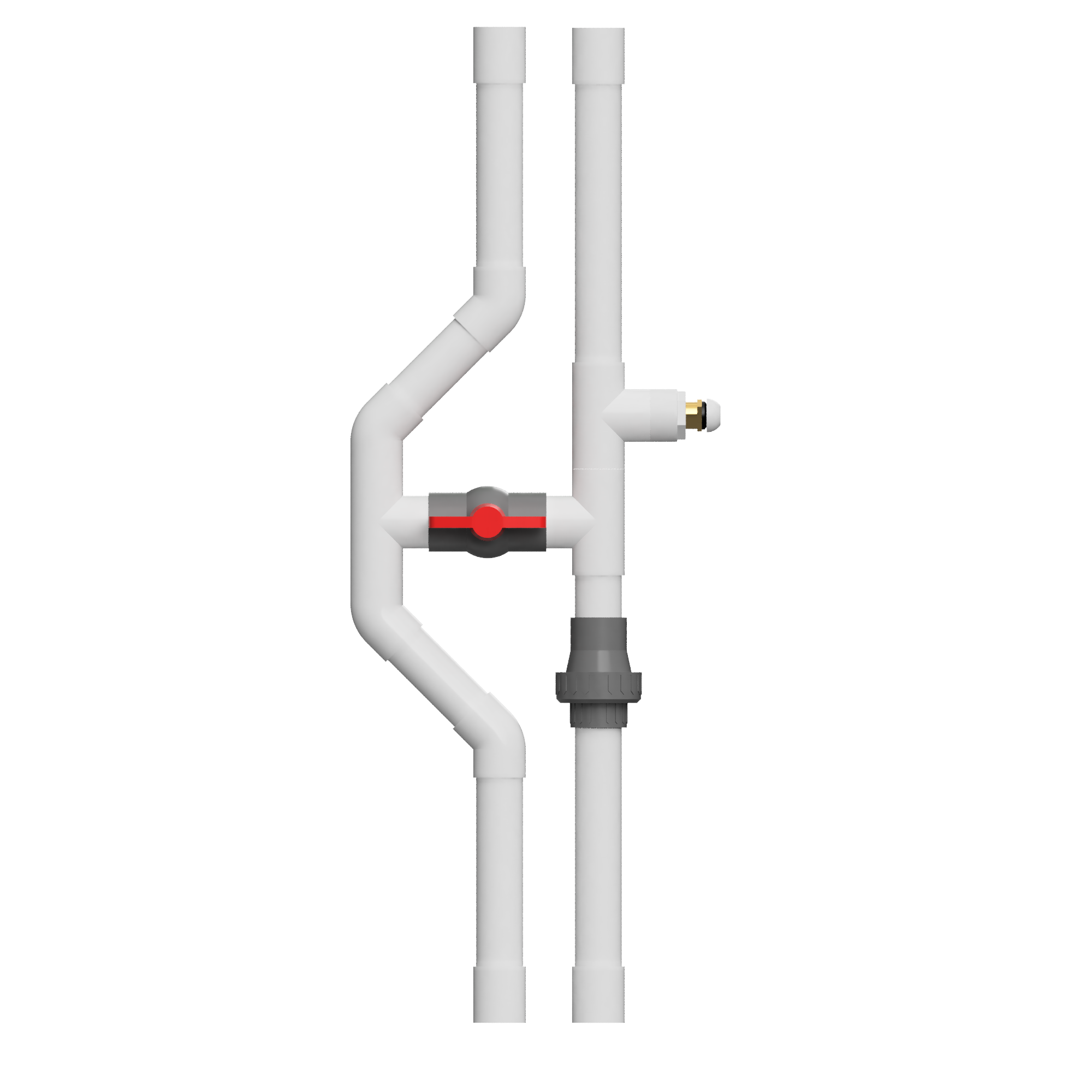
Nothing about the pool itself changes. Water still leaves through the weir, passes the pump and the filter, and comes back through the returns. Mineral Swim adds one control unit to that loop, on the wall beside the equipment you already have.
The pool
Water carrying dissolved Dead Sea minerals — well under 1% of it by weight.
Pump and filter
The equipment you already have, doing the job it already does.
The control unit
Back to the pool
Holding 0,5–1,0 ppm free chlorine instead of 2,0–3,0.
Chlorine, salt or minerals
All three are chlorine pools. What changes is where the chlorine comes from, how much of it sits in the water, and whose hands it passes through.
Chlorine pool
- In the water
- The chlorine you add
- Chlorine comes from
- A bucket or a drum, dosed by hand
- Free chlorine held
- 2,0–3,0 ppm
- Your part
- Buy it, carry it, measure it, pour it
Salt pool
- In the water
- Pool salt — sodium chloride
- Chlorine comes from
- A salt cell, automatically
- Free chlorine held
- 2,0–3,0 ppm
- Your part
- Top up the salt
Mineral pool
- In the water
- 100% Dead Sea minerals, magnesium-rich
- Chlorine comes from
- The mineral cell, with ozone taking most of the load
- Free chlorine held
- 0,5–1,0 ppm
- Your part
- Top up minerals — 4–5 bags a year
Every one of them still needs testing, pH correction, brushing and backwashing. Free chlorine figures are Maytronics’ published levels for a Mineral Swim pool and a conventional one. Salt against minerals, row by row — including where salt wins.
Softer water, less chlorine in it
The first thing most people notice is the feel. Magnesium-rich water feels softer than water running on plain salt, and at 0,5–1,0 ppm of free chlorine instead of 2,0–3,0 it makes for a softer, spa-like, therapeutic swim.
- Afternoons, not errands. The weekly chlorine run stops. The system makes what the pool needs, and the time goes back to the people in it.
- Less chlorine where you swim. About a third of the free chlorine of a conventional pool, made steadily by the cell.
- Still a pool to look after. You test, balance the pH and top up the minerals. Less effort, not no effort.

Mineral Swim, asked plainly
What is Mineral Swim, in one sentence?
A Maytronics pool system that swaps pool salt for 100% Dead Sea minerals and adds ozone, so the pool holds 0,5–1,0 ppm free chlorine instead of 2,0–3,0 ppm — and makes that chlorine itself.
Who makes Mineral Swim?
Maytronics, the company behind Dolphin robotic pool cleaners. It began in 1983 on Kibbutz Yizre’el in Israel. In 2024 Maytronics opened a production line in Australia for the current generation, Mineral Swim V2.
Where do the minerals come from?
The Dead Sea. They are sold as 100% Dead Sea minerals and they are magnesium-rich: roughly half of Dead Sea salt is magnesium chloride, where ocean salt is mostly sodium chloride. They dissolve into the pool where pool salt would go, and a typical pool uses 4–5 bags a year once it is established.
Will I float like I would in the Dead Sea?
No. The Dead Sea is about 34% salt, which is why people float in it. A Mineral Swim pool runs at 3 500–6 500 ppm of dissolved minerals — well under 1%. You swim in it the way you swim in any pool.
Is a Mineral Swim pool the same as a magnesium pool?
Near enough. “Magnesium pool” is the general name for a pool whose chlorinator runs on magnesium-rich minerals. Mineral Swim is Maytronics’ system for doing it, with ozone added. Magnesium pools, explained for South Africa.
Can my existing pool become a Mineral Swim pool?
Usually yes, and without draining it. The control unit mounts beside the pump and filter you already have, and the minerals go into the water that is already in the pool. What it takes depends on whether you dose chlorine by hand, run a salt chlorinator or already own an EcoSwim. How a conversion works.
Do you install it?
No. We supply the equipment and your own pool service fits it. Maytronics put the installation at under an hour, on the wall beside the pump and filter.
Pick up where you are
Tell us about your pool.
Send the size or the volume, and a photo of what is on the pump slab now. We will tell you which system fits and what it costs. We supply the equipment; your own pool service fits it.